1. Gatto, M. R., Mansour, A., Li, A., & Bentley, R. (2024).
“A State-of-the-Science Review of the Effect of Damp- and Mold-Affected Housing on Mental Health.” Environmental Health Perspectives, 132(8), 086001. https://doi.org/10.1289/EHP14341
Study Type / Design:
Systematic state-of-the-science review; screened 1,169 articles, included 19 high-quality studies.
Population & Exposure Type:
Adults and children living in damp or mold-affected housing (direct residential exposure); international scope.
Main Findings :
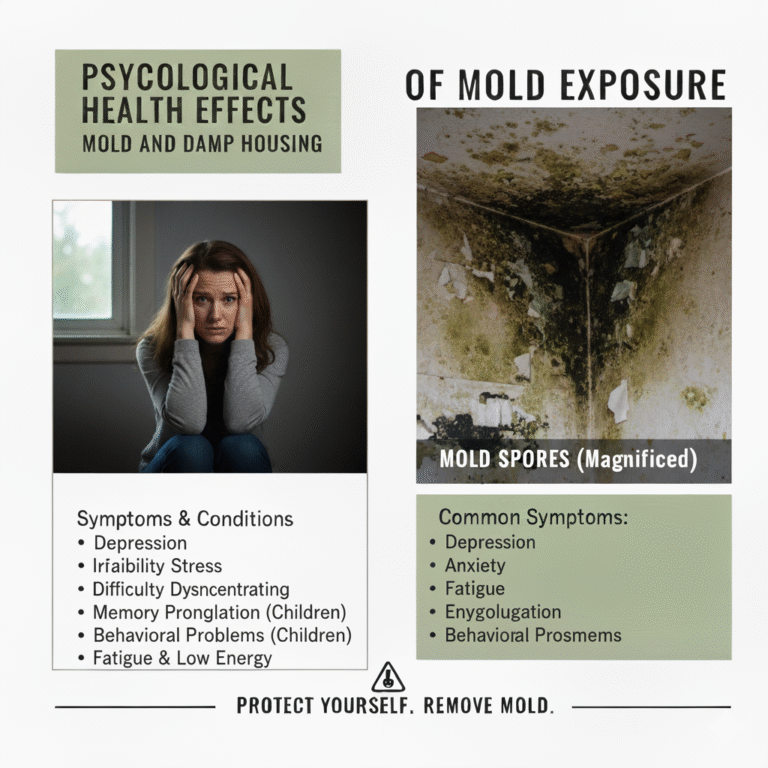
- Consistent positive associations between indoor dampness/mold and mental-health problems, especially depression, anxiety, and stress.
- In adults, the strongest links are with depressive and stress-related disorders.
- In children, there is an increased risk of emotional dysregulation and behavioral problems.
- The authors note that chronic low-grade inflammation, psychosocial stress, and odor perception may all mediate these effects.
Effect Size / Strength:
Most studies report adjusted ORs for depression/anxiety in the 1.3–1.8 range after confounder control.
Causation Level:
Probable causal — strong, replicated associations with consistent directionality and plausible biological mechanisms.
Notes / Limitations:
Heterogeneous exposure measurement; some reliance on self-reported dampness; publication bias possible; future longitudinal studies needed.
Quote:
“The available evidence described positive associations between residential dampness/mold exposure and poor mental health… In adults, associations were observed for depression, stress, and anxiety; for children, emotional symptoms and emotional dysregulation.” — Gatto et al., 2024, p. 6.
2. Hoxha, M., Abbasciano, M., Avantaggiato, G., Zappacosta, B., & Tricarico, D. (2025).
“Mycotoxins and Neuropsychiatric Symptoms: Possible Role and Mechanisms.” Frontiers in Pharmacology, 16, 1524152. https://doi.org/10.3389/fphar.2025.1524152
Study Type / Design:
Scholarly mini-review / opinion paper integrating human and mechanistic evidence on mycotoxin-induced neuropsychiatric dysfunction.
Population & Exposure Type:
populations exposed to environmental and dietary mycotoxins or living in mold-prone conditions; discusses at-risk groups (e.g., refugees, low-income housing).
Main Findings :
- Summarizes emerging evidence linking mycotoxin exposure to depression, anxiety, fatigue, and cognitive impairment.
- Discusses mechanisms including neuroinflammation, HPA-axis dysregulation, and oxidative stress.
- Calls for integration of psychiatric assessment in mycotoxin surveillance studies.
Effect Size / Strength:
No quantitative synthesis; emphasis on biological plausibility and cross-domain evidence.Causation Level: Associative / mechanistically plausible, not empirically proven.
Notes / Limitations:
Opinion-based review; not systematic; limited primary data.
Quote:
“Exposure to mycotoxins is associated with a higher risk of cognitive impairment, depression, anxiety, and other neuropsychiatric symptoms… further research is urgently needed to determine causal links.” — Hoxha et al., 2025, p. 3.
3. Shenassa, E. D., Daskalakis, C., Liebhaber, A., Braubach, M., & Brown, M. (2007).
“Dampness and Mold in the Home and Depression: An Examination of Mold-Related Illness and Perceived Control of One’s Home as Possible Depression Pathways.” American Journal of Public Health, 97(10), 1893–1899. https://doi.org/10.2105/AJPH.2006.093773
Study Type / Design:
Cross-sectional population-based analysis using the European LARES dataset (8 European cities; n ≈ 5,882 adults).
Population & Exposure Type:
Adults aged 18–64; direct residential exposure to visible mold, dampness, or mold odor documented by inspectors.
Main Findings :
- Residential dampness/mold is significantly associated with depressive symptoms (adjusted OR = 1.44, 95 % CI 1.10–1.89).
- Association remained after controlling for SES, crowding, unemployment, and other confounders.
- Mediating factor: Perceived loss of control over one’s housing partly explained the psychological distress.
Effect Size / Strength:
Adjusted OR = 1.44 (95 % CI 1.10–1.89) for depressive symptoms among exposed participants.
Causation Level:
Probable associative — strong, statistically significant relationship with plausible psychosocial and biological pathways.
Notes / Limitations:
Cross-sectional design (cannot infer temporal order); self-report of depression symptoms; verified building inspections mitigate reporting bias.
Quote:
“Living in damp, moldy households was associated with depression, even after adjustment for confounding factors, suggesting that the housing environment may independently contribute to poor mental health.” — Shenassa et al., 2007, p. 1893.