1. Hyvonen, S. M., et al. (2020).
“Association of toxic indoor air with multi-organ symptoms in pupils attending a moisture-damaged school in Finland.” American Journal of Clinical and Experimental Immunology, 9(5), 101–113. https://e-century.us/files/ajcei/9/5/ajcei0122200.pdf
Study Type / Design:
Cross-sectional case–control study of pupils from a moisture-damaged school (n=47) vs healthy control school (n=56).
Population & Exposure Type:
Children with direct exposure to a mold-contaminated environment.
Main Findings ( GI Outcomes):
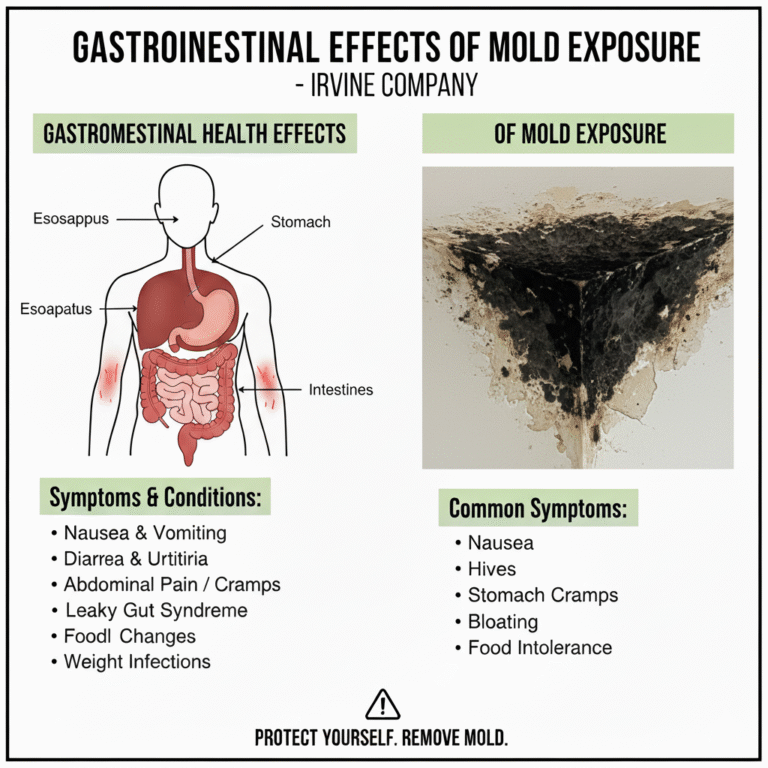
- Gastrointestinal symptoms (abdominal pain, nausea, dyspepsia) in 51% of exposed pupils vs 4% of controls (RR ≈ 14.3).
- Accompanied by respiratory and neurologic symptoms, confirming a multi-organ effect pattern.
Effect Size / Strength:
Relative risk ≈ 14.3; statistically significant.
Causation Level:
Associative but strong — cross-sectional yet exposure–response relationship clear.
Quote::
“Gastrointestinal problems (GI) were reported by 51% from the study cohort but only 4% of the control cohort (RR = 14.30).” — Hyvönen et al., 2020.
2. Institute of Medicine (IOM). (2004).
“Human Health Effects Associated with Damp Indoor Environments.” In Damp Indoor Spaces and Health, Chapter 5. National Academies Press (US). https://www.ncbi.nlm.nih.gov/books/NBK215639/
Study Type / Design:
Government-level systematic review of epidemiologic evidence.
Population & Exposure Type:
Adults and children in damp/mold-affected buildings.
Main Findings ( GI Outcomes):
- Several studies document nausea among occupants of damp indoor environments.
- Positions GI complaints as part of broader “building-related symptom” clusters.
Effect Size / Strength:
Varies per study; several statistically significant associations (Table 5–10).
Causation Level:
Associative — consistent observation, low specificity.
Quote::
“TABLE 5-10. Selected Epidemiologic Studies—Nausea and Related Symptoms and Exposure to Damp Indoor Environment or Presence of Mold… ” — IOM, 2004.
3.Quintero, O., Allard, L., & Ho, D. (2022).
“Invasive mold infection of the gastrointestinal tract: A case series of 22 immunocompromised patients from a single academic center. ” Medical Mycology, 60(3), myac007. https://doi.org/10.1093/mmy/myac007
Study Type / Design:
Retrospective case series of 22 immunocompromised patients with proven gastrointestinal mold infections.
Population & Exposure Type:
Hospitalized patients (hematologic malignancy, transplant, immunosuppressed) with confirmed invasive GI mold infections (histopathologic or culture).
Main Findings (Human GI Outcomes):
- Most frequent pathogens: Aspergillus spp. (41%), Mucorales (36%), Fusarium (14%).
- Sites: stomach, small intestine, colon; symptoms included abdominal pain, GI bleeding, perforation, necrosis.
- Mortality rate ≈ 59%.
- Demonstrates direct tissue invasion and systemic dissemination, and Confirms molds can systemically invade human organs beyond the lungs.
Effect Size / Strength:
Strong clinicopathologic evidence; invasive infection confirmed by biopsy.
Causation Level:
Definitive causal (pathologically proven) — establishes molds can directly infect and destroy GI tissue in humans under immunocompromised conditions.
Notes / Limitations:
Highly specific (immunocompromised population); not representative of general environmental exposure.
Quote::
“All cases met EORTC/MSG criteria for proven invasive mold infection of the gastrointestinal tract… the most common presenting symptom was abdominal pain.” — Quintero et al., 2022.