1. Tuuminen, T. & Rinne, J. (2017).
“Severe Sequelae to Mold-Related Illness as Demonstrated in Two Finnish Cohorts.” Frontiers in Immunology case report. PMCID: PMC5377931. https://www.ncbi.nlm.nih.gov/pmc/articles/PMC5377931/
Study Type / Design:
Case series describing two Finnish families exposed to mold-contaminated homes.
Population & Exposure Type:
Direct residential exposure to visible mold and dampness; all family members are chronically exposed.
Main Findings (Dermatologic):
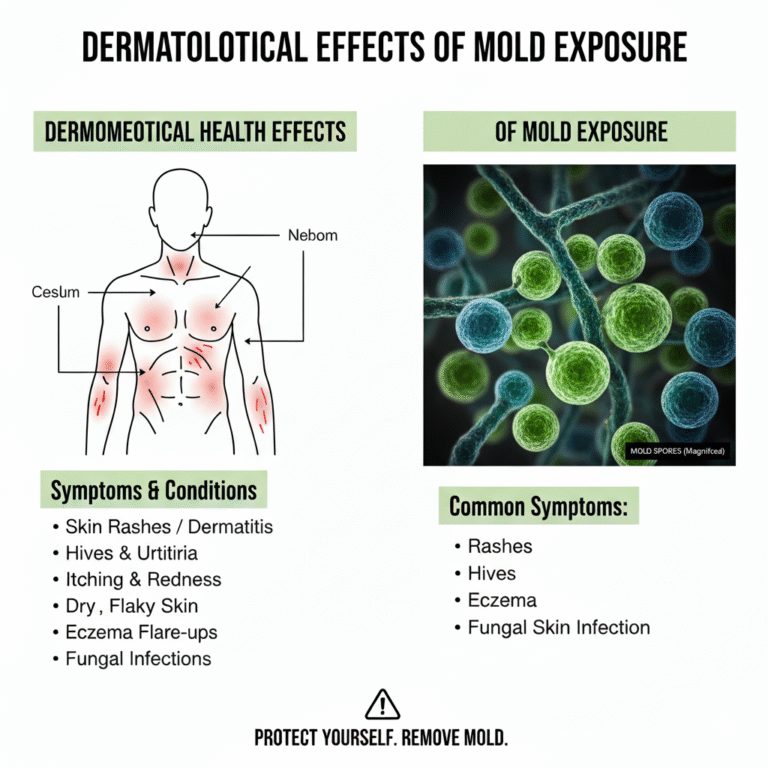
- Reported skin symptoms, including itching, dermatitis, and eczema-like lesions, are often
- concurrent with respiratory and neurological issues.
- Improvement observed after relocation to mold-free environments.
- Skin and mucosal irritation are interpreted as part of a multi-organ hypersensitivity response.
Causation Level:
Associative — temporal correlation and symptom resolution post-remediation suggest a possible causal link.
Quote::
“The first cohort experienced mucosal irritation, neurological, skin, allergic, and other symptoms… all family members ultimately developing a number of chronic complaints.” — Tuuminen & Rinne, 2017, PMC5377931.
2. Valtonen, V. (2017).
“Clinical Diagnosis of the Dampness and Mold Hypersensitivity Syndrome: Review of the Literature and Suggested Diagnostic Criteria.” Frontiers in Immunology, 8:951. https://doi.org/10.3389/fimmu.2017.00951
Study Type / Design:
Clinical literature review proposing diagnostic criteria for Dampness and Mold Hypersensitivity Syndrome (DMHS).
Population & Exposure Type:
patients with chronic exposure to moldy indoor environments, including workplaces and homes.
Main Findings (Dermatologic):
- Describes cutaneous and mucocutaneous irritation, itching, and rashes among frequent clinical findings.
- Notes that skin hypersensitivity and dermatologic inflammation are part of the systemic response pattern in DMHS.
- Recommends clinicians recognize recurrent skin and mucosal reactions as supportive diagnostic clues.
Effect Size / Strength:
Qualitative clinical frequency data from published cases; not quantified.
Causation Level:
Probable associative — recurring symptom pattern with consistent exposure–response relationship.
Quote::
“The clinical picture of dampness and mold hypersensitivity syndrome includes inflammatory, neurological, and systemic manifestations… often accompanied by mucosal and skin irritation that typically improves when exposure ceases. — Valtonen, 2017, p. 951.
3. Johanning, E., Biagini, R., Hull, D., Morey, P.., Jarvis, B., & Landsbergis, P.. (1998).
“Stachybotrys chartarum (atra) Contamination of the Indoor Environment: An Overview of Exposure Effects.” Environmental Health Perspectives, 106(Suppl 6), 1071–1080. https://doi.org/10.1093/pch/4.2.125
Study Type / Design:
Comprehensive clinical and toxicologic review synthesizing early human outbreak reports and mechanistic data.
Population & Exposure Type:
Occupants of Stachybotrys-contaminated buildings (direct exposure); includes workers and residents.
Main Findings (Dermatologic):
- Dermatitis, rash, and skin inflammation were documented among building occupants exposed to S. chartarum spores and mycotoxins.
- Identifies mycotoxins (trichothecenes) as irritants causing cutaneous burning, erythema, and vesicular eruptions.
- Describes dose-dependent irritation and localized dermatitis in exposed workers.
Effect Size / Strength:
Qualitative synthesis; early case-series data cited.
Causation Level:
Probable cause for irritant/contact dermatitis in heavily exposed individuals (mechanistic evidence from trichothecene toxicity).
Quote::
“Dermatitis, mucosal irritation, and other inflammatory responses have been reported in building occupants exposed to Stachybotrys chartarum and its trichothecene toxins.” — Johanning et al., 1998, p. 1076