1. Mendell, M. J., Mirer, A. G., Cheung, K., Tong, M., & Douwes, J. (2011).
“Respiratory and allergic health effects of dampness, mold, and dampness-related agents: A review. ”
Environmental Health Perspectives, 119(6), 748–756. https://doi.org/10.1289/ehp.1002410
Study Type / Design:
Narrative systematic review of approximately 500 epidemiological studies.
Population & Exposure Type:
Adults and children with direct exposure to residential and occupational damp or moldy buildings.
Main Findings:
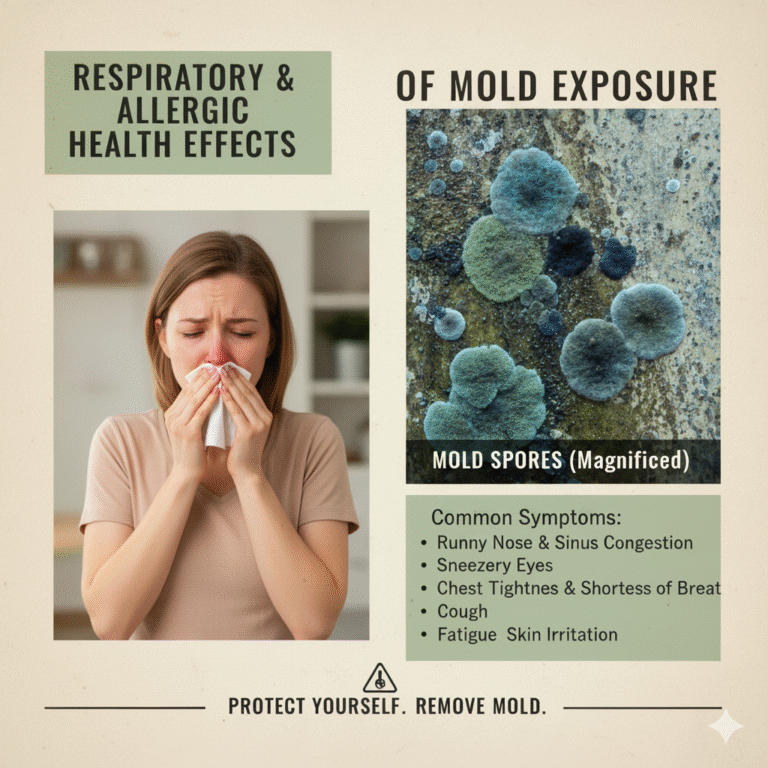
- Strong, consistent association with asthma exacerbation and new-onset asthma.
- Elevated prevalence of cough, wheeze, dyspnea, and allergic rhinitis.
- Respiratory infections and symptom severity increase with mold intensity.
Effect Size / Strength:
OR ≈ 1.3 – 1.7 (qualitative synthesis from included studies).
Causation Level:
Causal for asthma exacerbation; probable causal for asthma onset.
Notes / Limitations:
Observational bias possible (self-reported exposure); large global dataset strengthens generalizability.
Quote:
The evidence reviewed consistently indicates that the presence of dampness or mold in buildings is associated with increased prevalence of respiratory symptoms, respiratory infections, and exacerbation of asthma.— Mendell et al., 2011, p. 753.
2. Caillaud, D., Leynaert, B., Keirsbulck, M., & Nadif, R. (2018).
“Indoor mould exposure, asthma and rhinitis: Findings from epidemiological studies.”
European Respiratory Review, 27(148), 170137. https://doi.org/10.1183/16000617.0137-2017
Study Type / Design:
Mechanistic narrative review integrating epidemiological and mechanistic evidence.
Population & Exposure Type:
General population and occupational groups (Europe-focused); direct residential or workplace
exposure to visible mold, musty odor, or dampness.
Main Findings:
- Confirms consistent associations between mold exposure and asthma/rhinitis.
- Identifies both IgE-mediated (allergic) and β-glucan–mediated (non-allergic) inflammatory mechanisms.
- Reports dose-response pattern between mold odor intensity and respiratory symptoms.
Effect Size / Strength:
OR ≈ 1.3 – 1.8 across pooled analyses.
Causation Level:
Causal for asthma exacerbation; likely causal for asthma onset and rhinitis.
Notes / Limitations:
Exposure heterogeneity (inspection vs self-report); strong mechanistic coherence; confounding
adjusted in most analyses.
Quote:
“The strength and consistency of these associations, combined with experimental
data showing inflammatory responses to mould components such as β-glucans and
MVOCs, support a causal relationship for asthma and rhinitis.”— Caillaud et al., 2018, p. 170137-8.
3. Quansah, R., Jaakkola, M. S., Hugg, T. T., Heikkinen, S. A., & Jaakkola, J. J. K. (2012).
“Residential dampness and molds and the risk of developing asthma: A systematic review and meta-analysis.”
PLOS ONE, 7(11), e47526. https://doi.org/10.1371/journal.pone.0047526
Study Type / Design:
Systematic review and meta-analysis (20 studies: 12 child, 8 adult).
Population & Exposure Type:
Adults and children with direct residential exposure to visible mold, damp spots, or musty odor.
Main Findings:
- Significant increase in new-onset asthma risk in both children and adults.
- Strongest associations for visible mold exposure.
- Dose-response gradient evident with mold extent and odor intensity.
Effect Size / Strength:
Pooled OR = 1.50 (95 % CI 1.30–1.74).
Causation Level:
Causal — supported by consistency, temporality, and biological plausibility.
Notes / Limitations:
Moderate heterogeneity (I² ≈ 60 %); exposure often self-reported; robust across sensitivity analyses.
Quote:
“The overall meta-analysis showed a significant positive association between
exposure to dampness or molds and the development of asthma (OR = 1.50; 95 %
CI 1.30–1.74).”— Quansah et al., 2012, p. e47526.
4. Groot, J., van Strien, R. T., Koppejan, M., et al. (2023).
“Exposure to residential mold and dampness and risk of respiratory tract infections in children: A systematic review and meta-analyses.”
Paediatric Respiratory Reviews, 48, 47–64. https://doi.org/10.1016/j.prrv.2023.06.003
Study Type / Design:
Systematic review and meta-analysis (28 studies, >160,000 children).
Population & Exposure Type:
Children exposed to visible household mold or dampness; direct residential exposure only.
Main Findings :
- Significant association between household mold/dampness and increased risk of respiratory tract infections (RTIs).
- The effect remains after adjustment for socioeconomic status, crowding, and parental smoking.
- Strongest for lower RTIs (pneumonia, bronchitis).
Effect Size / Strength:
Pooled OR = 1.44 (95 % CI 1.29–1.60).
Causation Level:
Probable causal — meets criteria for consistency, strength, and plausibility.
Notes / Limitations:
Moderate heterogeneity (I² ≈ 58 %); reliance on parental reporting; insufficient data from low-income countries.
Quote: :
“Meta-analysis showed that children exposed to visible mould or dampness in their homes had a 44 % higher odds of developing respiratory tract infections compared with unexposed children (OR 1.44, 95 % CI 1.29–1.60).”— Groot et al., 2023, p. 52.